
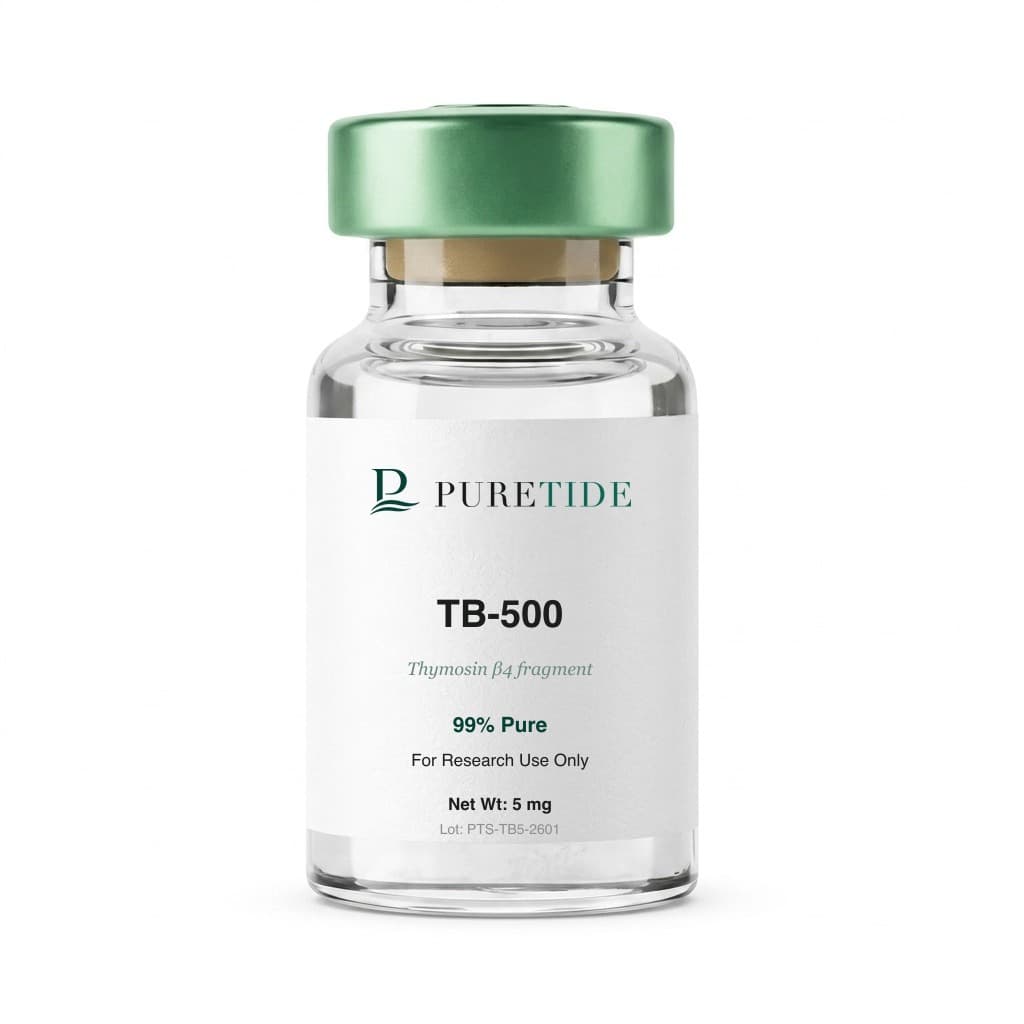
Repair & Recovery · Placeholder catalog data
TB-500
Also known as Thymosin β4 fragment
A synthetic peptide corresponding to an active region of Thymosin β4, an actin-binding protein involved in cell migration and wound repair in preclinical models.
160 credits
Paid from your credit pool at checkout. Bulk quantities discount automatically.
Available variants
Pricing and fulfillment information is placeholder data.
| Amount | SKU | Credits | MSRP | Availability | Margin estimate |
|---|---|---|---|---|---|
| 5 mg | PTS-TB5-5 | 32 credits | $45 | Ready | 29% estimate |
| 10 mg | PTS-TB5-10 | 35 credits | $69 | Ready | 49% estimate |
Margin estimate treats 1 credit as $1 and compares estimated wholesale credit cost with placeholder MSRP. It excludes shipping, taxes, and other costs.
Buy more, save more
Quantity breaks apply per line item and are deducted automatically at checkout.
| Quantity per line | Discount | Example (5 mg unit) |
|---|---|---|
| 10+ units | 5% off | 10 × 32 credits → 304 credits |
| 25+ units | 10% off | 25 × 32 credits → 720 credits |
| 50+ units | 15% off | 50 × 32 credits → 1,360 credits |
| 100+ units | 20% off | 100 × 32 credits → 2,560 credits |
Specifications
- CAS
- 77591-33-4
- Formula
- C212H350N56O78S
- Molecular weight
- 4963.44 g/mol
- Sequence
- Ac-SDKPDMAEI
- Purity
- ≥99%
- Appearance
- White lyophilized powder
- Storage
- Store lyophilized at −20 °C, protected from light and moisture
Quality record
COA status
COA listedLot PTS-TB5-2607
Placeholder reference. Verify the active lot before ordering.
Research background
Thymosin β4 is a 43-amino-acid G-actin sequestering protein expressed in nearly every mammalian cell type. TB-500 is a synthetic fragment used in preclinical studies to investigate the peptide's influence on cell migration, angiogenesis, and extracellular matrix remodeling.
Literature has examined its role in models of myocardial repair, corneal wound healing, dermal injury, and tendon regeneration. Research has described upregulation of endothelial cell differentiation and modulation of inflammatory infiltrate in injured tissue.
TB-500 is studied strictly as a laboratory reagent. It is not approved for therapeutic or veterinary use.
Mechanism: Research describes G-actin sequestration, promotion of cell migration via actin cytoskeletal reorganization, and upregulation of VEGF and laminin-5 in injury models.
Research use only
For research use only. Not for human or veterinary use.